Waiting for Spring Hat and Shoulder Wrap Set

IMG_3259


* To change colors, fasten off with previous color and join with a sl st in the same space that you previously fastened off.

* I usually weave in the ends as I go along so that I’m not overwhelmed at the end of the project.
Hat:

Square Strip:

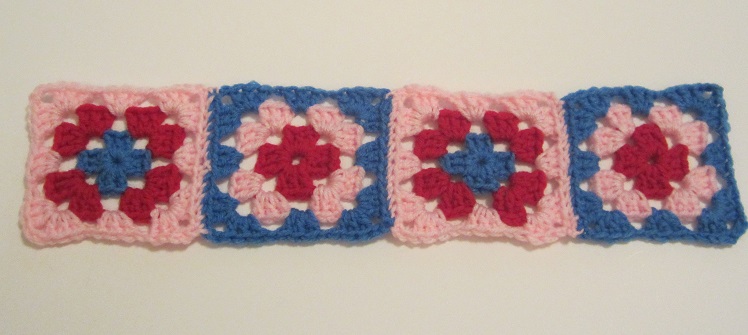
The squares are simple granny squares.

* Use F (3.75MM ) hook and Red Heart Super Savor Yarn.

Ch 6, join with a sl st in first ch to form a ring.

Rnd 1: Ch 2, (counts as first dc), 2 dc in circle, ch 3, (3dc, ch 3) three times, and then join with a sl st in first dc.
(12 dc and 4 ch-3 corner spaces)

Rnd 2: If using the same color, sl st to the nearest ch-3 space. If using different color, join with a sl st in any ch-3 space. Ch 2, (2dc, ch 3, 3dc), ch 1. (3dc, ch 3, 3dc, ch 1) in each of the ch-3 spaces around. Jn with a sl st in first dc.
(24 dc, 4 ch-1 spaces, 4 ch-3 spaces)

Rnd 3: If using the same color, sl st to the nearest ch-3 space. If using different color, join with a sl st in any ch-3 space. Ch 2, (counts as first dc), (2dc, ch 3, 3dc, ch 1) in corner. (3dc, ch 1) in ch-1 space. *(3dc, ch 3, 3dc, ch 1) in next corner, (3dc, ch 1) in next ch-1 space. Repeat from * two more times and jn with a sl st in first dc. Fasten off leaving a little bit of a tail to sew one side of this square to the side of another square.

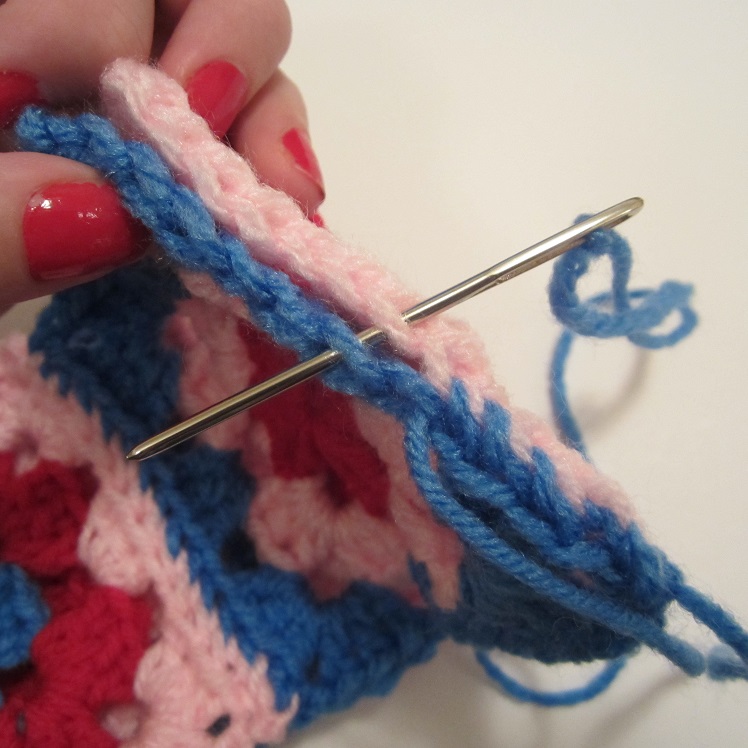
*Make squares, sewing them together side-by-side, until there are enough to fit comfortably around your head, (I make 7 squares), then sew the ends of the last two squares together. I personally like to have a little bit of a rough look when sewing mine together, so I hold the wrong sides together and weave the yarn in and out of the inside/back/bottom loops only. Like…the loops that are closest together when holding the wrong sides together.
sewingtogetheratbackloops

Outlining the squares:

*Use a size K hook.

First Round: Work in the back loops of all the stitches possible and inside the actual chain if you’re working in the chain space. Jn desired color with a sl st into any right side corner of one of the squares.

For a little wider, more spacious fit: Ch 2, *(dc in each of the next 3 st, dc in ch-1 space) twice. Dc in next 3 st, dc decrease using the last corner of the square and the first corner of the next square. Repeat from * around the strip. Jn with a sl st in first dc. Fasten off.

OR

For a more snug fit, and my preferred fit: Ch 2, *(dc in each of the next 3 st, skip ch-1 space,) twice, dc in next 3 st, dc decrease using the last corner of the square and the first corner of the next square. Repeat from * around.

*The first side you work in this way will be the side you attach to the upper half of the hat once you make it. To make the bottom (open) end of the hat, you’ll flip the strip over and repeat. The fasten off leaving a tail long enough to sew this part of the hat to the top (crown) of the hat once you complete it.

Second Round for bottom of hat: For the last round of the brim of the hat you’ll be working in the back (inside) loops all around. Jn with a sl st in the back loop of any st. Ch 2, hdc in next st and around. Jn with a sl st in the first dc. Fasten off and weave in ends.

*Note: If you feel the hat is a little too wide, simply skip the two ch-1 spaces on each square and don’t work dc into those chains as you would for the ‘snug fit’ option above.
Crown of the hat:

*Use a K hook

*On the round after I switch colors, I like to work in the back loops only of the round with the new color, but this isn’t necessary unless you also like the little ‘line’ that appears as a result as well.

Rnd 1: Ch 4, join to form a ring. Ch 2, (counts as dc here and throughout pattern), 9dc in ring. Jn in first dc to close round here and at the end of each rnd. (10 dc)

Rnd 2: Ch 2, dc in same st, 2 dc in each st around. Join. (20 dc)

Rnd 3: Ch 2, 2 dc in next st, (dc, 2dc) around. Join. (30 dc)

Rnd 4: Ch 2, Dc in next st, 2 dc, (dc, dc, 2dc) around. Join. (40 dc)

Rnd 5: Ch 2, dc in next 2 sts, 2 dc, (dc, dc, dc, 2dc) around. Join. (50 dc)

Rnds 6: Ch 2, dc in next 3 sts, 2 dc, (dc, dc, dc, dc, 2dc) around. Join. (60 dc)

Rnd 7: Ch 2, dc in next st and around. Jn. Repeat this round until hat his desired length when you add the square strip of the hat)

* Sew the crown of the hat to the strip of squares with a yarn hook by weaving the needle in and out of the back (inside) loops. Fasten off and weave in ends.

*Note: This is the basic way I make all of my hats. If you want a simple dc hat, you can repeat Rnd 7 all the way down until the hat is as long as you want it, even adding many extra rounds for a slouchy beanie. For a kid’s hat, work from Rnd 1 and stop when you get the hat just wide enough that you could skip down to Rnd 7 and repeat it until the hat is as long as you want it. For a kid’s version of this particular hat, you could even make only one or two rounds of the squares so they are smaller (or switch to an F hook for the squares only so you can keep the number of rounds and color combinations) and see how that works to tiny it up!


*****************************************************
IMG_3249
Cowl or Shoulder Wrap

Squares:
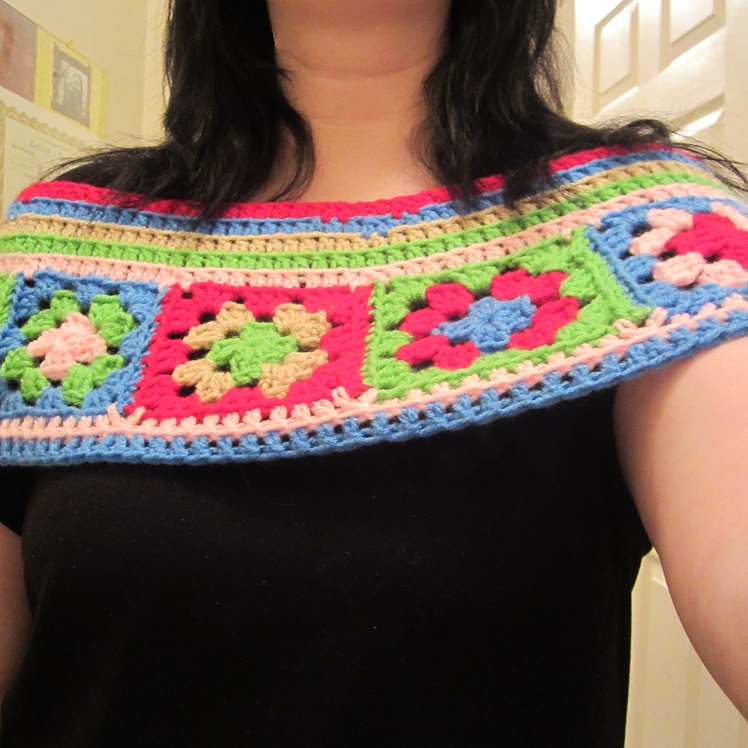
Make squares like the ones for the hat, only use a K hook because they can be larger. Make the squares and connect them until they are as wide as you want your cowl (or shoulder wrap) to be.

Then Jn desired color yarn with a sl st and dc around in the same manner as I mentioned for the border on the hat:

Stripes:

For a little wider, more spacious fit: Ch 2, *(dc in each of the next 3 st, dc in ch-1 space) twice. Dc in next 3 st, dc decrease using the last corner of the square and the first corner of the next square. Repeat from * around the strip. Jn with a sl st in first dc. Fasten off.

For a more snug fit, and my preferred fit: Ch 2, *(dc in each of the next 3 st, skip ch-1 space,) twice, dc in next 3 st, dc decrease using the last corner of the square and the first corner of the next square. Repeat from * around.

Then simply repeat double crocheting around evenly on each side of the square patch until cowl is as tall as you’d like. Example: Jn with sl st, ch 2, dc in next st and around, jn with a sl st in first dc to join round.


Now take adorable pictures with your kitty cat!!!
Now take adorable pictures with your kitty cat!!!


Posted in Uncategorized | Tagged , , , , , , , , , , , , , , , , , , | Leave a comment

Waiting for Spring Plant Hanger

IMG_3265

Waiting for Spring Plant Hanger

Do your plants need some style? Do they want to strut their sexy, luscious leaves and flex their stems at the outdoor plants on the other side of the window? I would if I was a plant!

I use a size K (6.50MM) hook, Red Heart Super Saver Yarn, and a yarn needle to sew the project together and help me weave in the ends.

* To change colors, fasten off with previous color and join with a sl st in the same space that you previously fastened off.

* I usually weave in the ends as I go along so that I’m not overwhelmed at the end of the project.

*Make sure the yarn you use is strong enough to hold the plant securely when you add dirt to the plant. I wouldn’t try to hang anything really heavy with a yarn hangerJust little house plants.

IMG_3194

Squares:

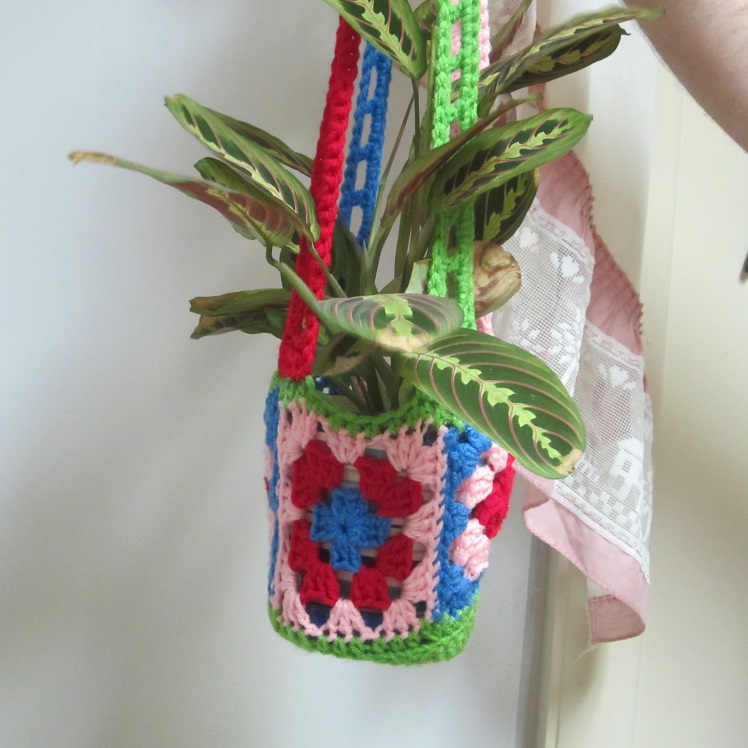
The squares are simple granny squares. You’ll want to start with the first round or two and then keep working outwards in the same pattern until the square is as tall as you want your plant hanger. Then make as many squares as needed to circle your plant pot when you sew them together.

Rnd 1: Ch 6, jn with a sl st in first ch to form a ring. Ch 2, (counts as first dc), 2 dc in circle, ch 3, (3dc, ch 3) three times, and then join with a sl st in first dc.
(12 dc and 4 ch-3 corner spaces)

Rnd 2: If using the same color, sl st to the nearest ch-3 space. If using different color, join with a sl st in any ch-3 space. Ch 2, (2dc, ch 3, 3dc), ch 1. (3dc, ch 3, 3dc, ch 1) in each of the ch-3 spaces around. Jn with a sl st in first dc.
(24 dc, 4 ch-1 spaces, 4 ch-3 spaces)

Rnd 3: If using the same color, sl st to the nearest ch-3 space. If using different color, join with a sl st in any ch-3 space. Ch 2, (counts as first dc), (2dc, ch 3, 3dc, ch 1) in corner. (3dc, ch 1) in ch-1 space. *(3dc, ch 3, 3dc, ch 1) in next corner, (3dc, ch 1) in next ch-1 space. Repeat from * two more times and jn with a sl st in first dc. Fasten off leaving a little bit of a tail to sew one side of this square to the side of another square.
* You can stack your squares to make the hanger taller if you desire, or you could keep working outward in rounds. If you choose to keep adding rounds, just add (3dc, ch-1) in each of the side spaces and (3dc, ch 3, 3dc, ch 1) in each corner like you have been doing. You could make a blanket that way if you wanted to! I have before!

* If your squares are just too short to reach, but you can’t fit another square in there, you could just add one or two dc or sc rows evenly along a few of the squares to make it fit perfect.
Sew your squares together.

IMG_3217

IMG_3226

Border:

If you would like a border on the top and bottom of your squares, what I do is:

Jn yarn with a sl st in the st right before one of the square’s left corners. *Double crochet decrease using the two touching corners of the squares. Then hdc in next three stitches, skip the ch-1 space, hdc in the next three stitches (for as many or few of these center stitches as you’ve created depending on how small or large your square is) and then double crochet decrease in the next touching corners. Repeat from * around and jn with a sl st in beginning stitch. Repeat for other side.

IMG_3229

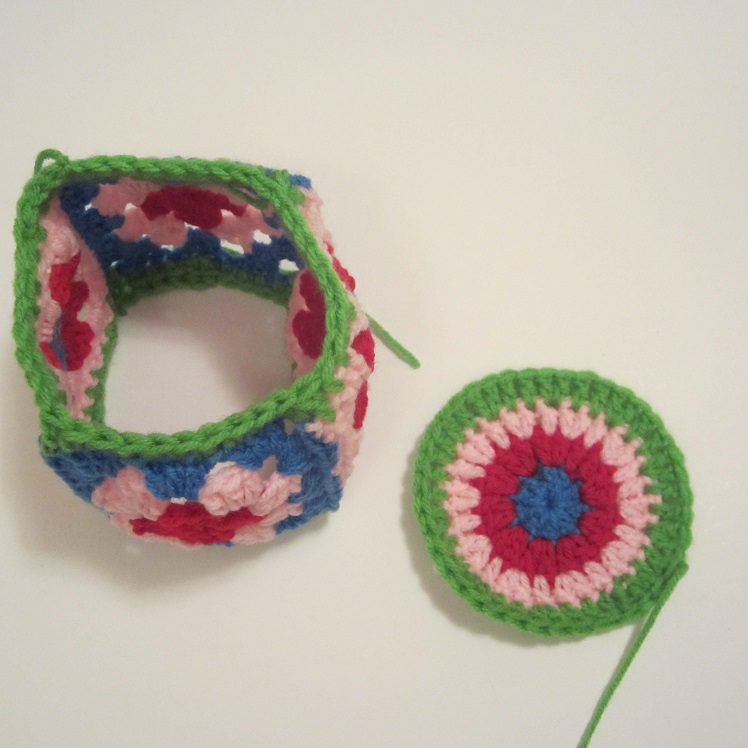
For the bottom circle:

I’m going to show you a pattern I LOVE for creating circles. I don’t know if it works forever outwards, as in if you wanted to make a circle blanket because I haven’t tried making a circle that large before, but I have used this pattern for many, many smaller circular projects:

Rnd 1: Ch 4, jn with a sl st in first ch to form a ring. Ch 2, (counts as first dc here and throughout), work 9 dc in ring. Jn with a sl st in first dc. (10 dc)

Rnd 2: Ch 2, dc in same st, 2 dc in each st around. Jn. (20 dc)

Rnd 3: Ch 2, dc in same st, (dc, 2dc) around. Jn. (30 dc)

Rnd 4: Ch 2, dc in same st, (dc, dc, 2dc) around. Jn. (40 dc)

You continue this pattern, stopping when the circle is as large as you want. You increase the number of dc before your 2dc by one with each round. So you begin each round the same: Ch 2, dc in same st. You end the rounds the same by joining with a sl st. The pattern will go like this starting with round 5:
Rnd 5: (dc, dc, dc, 2dc) around.

Rnd 6: (Dc, dc, dc, dc, 2dc) around.

Rnd 7: (Dc, dc, dc, dc, dc, 2dc) around.

 IMG_3232

Sew the bottom to the bottom in place.

IMG_3235

Handles:

(Make 4)

Rw 1: Ch 51, sc in 2nd ch from hook and in each chain across, ch 1, sl st in the same space as your very last sc.

Rw 2: Ch 2, pivot. Dc in same st. (Ch 2, sk next 2 st, dc in next st) across. (Add a dc in any extra stitches at the end if you miscounted at some point. Then you won’t have to start all over! *wink* Well…plus my math might be off here.)

Rw 3: Ch 1, turn, sc in same st. (2sc in ch-2 space, sc in dc) across. To make the end more strong and make it easier to have stitches to sew the handle to the pot base: Sc a second time inthe last stich, shift work, sc in center, 2sc in other corner. Jn with a sl st in very first sc. Fasten off at end leaving a tail long enough to set handle to plant pot firmly and securely.
Sew the handles to the sides of the plant hanger and then either stitch the tops of them together very securely, or loop them all onto whatever you’re hanging the pot from.

IMG_3266

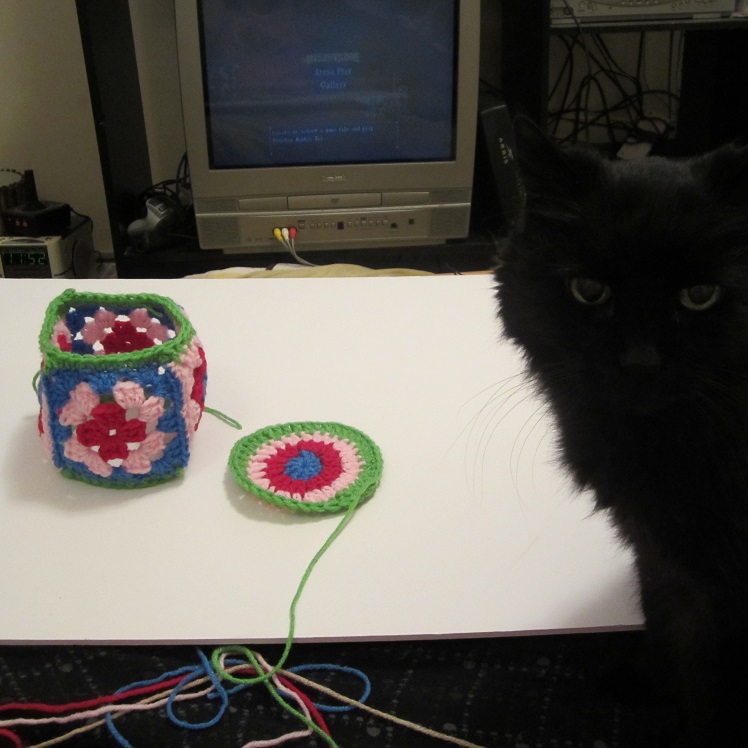
You might need to get your kitty to help you construct your project like Mizzy the Kitty helps me all the time.

You might need to get your kitty to help you construct your project like Mizzy the Kitty helps me all the time.

Posted in Uncategorized | Tagged , , , , , , , , , , , , , , , , , , , , | 4 Comments

No Time for After-Holiday Blues! Time for Project Planning Excitement!

This is me going crazy without sleep when I can't stop crocheting every project I see.

This is me going crazy without sleep when I can’t stop crocheting every project I see.


Good morning, ghoulz!

There’s no time for after-holiday blues around here! We need to get busy in the most fun kinda way! Now is the time to clear out your old project lists, drag out your new calendar and take note of all the holidays, birthdays, etc… throughout the year, and start planning your projects!

Whether you’ll be making gifts or if it’s just one of those years you’re going to finally take time to create themed decorations for your own home that you can pass down the patterns for generations to come, (or share with friends that ask about them), we crafters can’t afford to have anything sneak up on us! We need time, man! Oh, and it’s gonna be so much stitchy fun!!!!

Valentines Day, Veterans Day, Awareness ribbons for everything we know of and care about, secret sister gifts, Easter, 4th of July! What charity project are you going to do this year? Are you in a club? Are you gonna set some big goals to crochet as a whole? Find someone to teach your craft to that’s been hinting about it! Learn a new stitch for your own adorable arsenal!

I like to keep up with all the patterns I find and all the projects I might work on, on the crochet sites that let you make project lists. I need to organize all those, and if you don’t follow one, it’s time to make you a profile! Check out Ravelry.com, Pinterest, all the yarn sites like Red Heart Yarns, Caron, Lionbrand, etc..

What are you’re favorite sites where you keep up with stuff, ghoulz? Help us to get organized and get excited about all the fun stuff there is to do throughout the year! No time for the after holiday apathy here! 🙂

~ Starling


You can check out my free patterns on Ravelry and create a profile of your own to keep up with your projects here!

You can read my post about yarn organization here!

Get some ideas from my blog post here about what you might want to search for, for charity project ideas in your area!

I have a list of links to my favorite free pattern sites here!

If you’re new to crocheting, or are teaching someone to crochet and want them to have a couple back up videos for the basics for when they’re at home, remember my Crochet Instruction page where I have links to videos and lots of crochet info!


Have fun  and good luck! Party on, goulz!


Posted in Uncategorized | Tagged , , , , , , , , , , , , , , , , , | Leave a comment

Hexagon Boots (Starling’s Lazy Version)

IMG_3149

IMG_3140

adminstarlingslegs

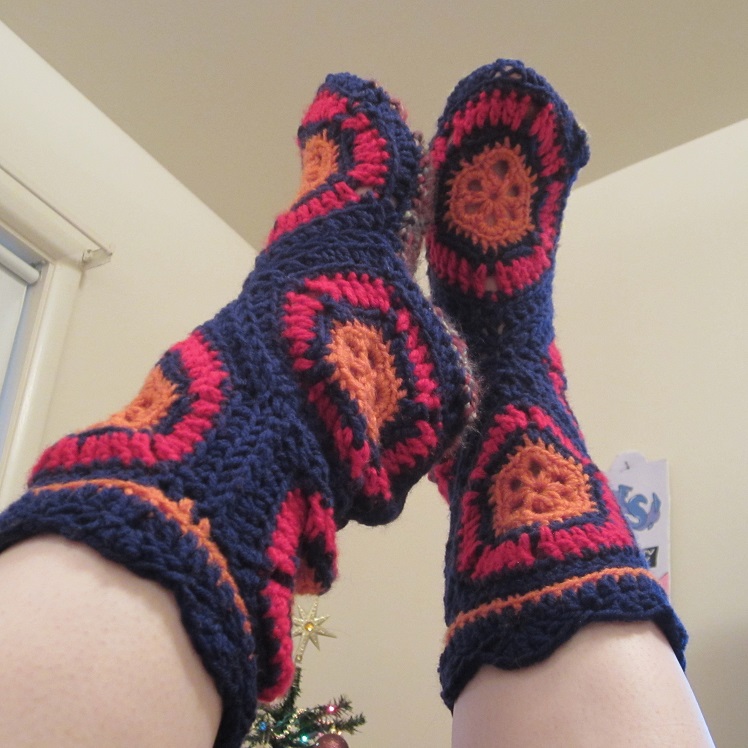
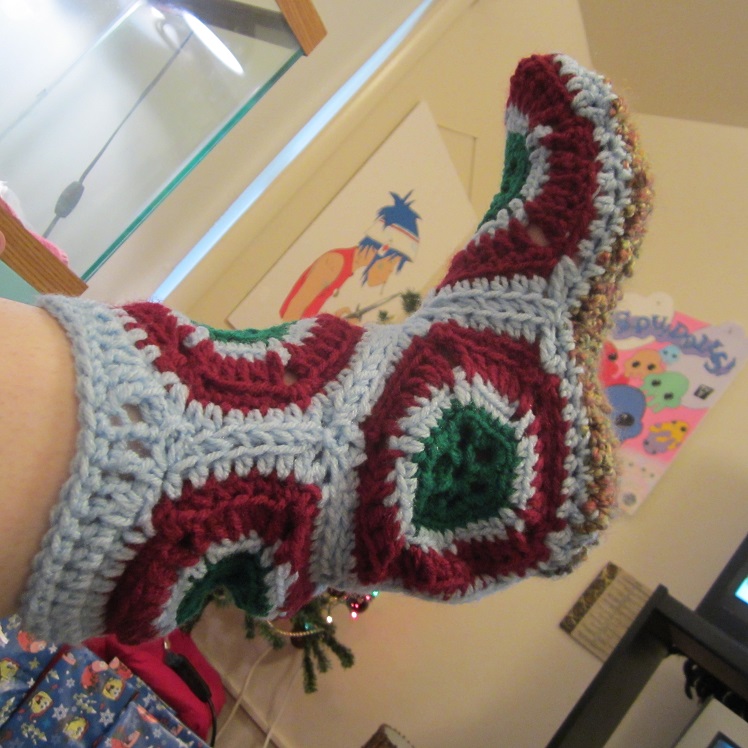
Hexagon Boots

* The inspiration for these shoes came from the beautiful shoes you can see here. They link to the free pattern that they used and that pattern seems pretty well informative about sizing. My hexagon has a different stitch so there’s less work.  I am, as my ghoulz know, a lazy crocheter, so I had to make my own pattern using larger stitches/hook, cheaper yarn, etc…because I like instant gratification. The other thing I did very different from the original pattern was that my design kind of flattens the straight edges of the hexagons a little more, especially in the heel because the original ones kept leaving me with this weaird hump on the back of the boot from the point of the hexagon. In this pattern I really try to flatten those sides more fully. The inspiration shoes are gorgeous, though, so you should check those out too!

Size K (6.50MM) hook and Red Heart Super Saver Yarn and a yarn needle. LionBrand Homespun yarn for the bottom of the boot.

*See after pattern and pictures for sizing suggestions and troubleshooting. These are for size 8 or 9, but I bet you can figure out your own size pretty easy!

Altered Hexagon for the Top of the Boot Over the Toes (One per foot):

Rnd 1: Ch 5, join in the first chain to form a ring. Working this round in the ring, ch 1, (sc, ch 3,) 6 times. Join with a sl st in first sc. (6 sets of ch-3 arches.)

Rnd 2: Join with a sl st in any ch-3 space. Ch 1. Work 5 sc in each ch-3 space around. Join with a sl st in first sc.

Rnd 3: Working in back loops only for the entire round: Join with a sl st in the center st of any 5-sc spots. Ch 3 (works as first hdc, ch-1), sc in the next 4 sc, ch 1, dc in the next (center) sc, ch 1. (sc in next 4 sc, ch 1, hdc in center sc, ch 1) 5 times. Join with a sl st in the 3rd chain of the first ch-3. Fasten off and weave in ends.
Rnd 4: Jn with a sl st in any ch space before a dc. Ch 4, (counts as first dc/ch4), dc in next ch space. (Dc in the back loops of next 4 st, dc in next ch space, ch 2, dc in next ch space) 4 times. Dc in the back loops on next 4 st, sc in next ch space, ch 1, sc in next ch space, dc in the back loops of last 4 st. Jn with a sl st in 2nd ch of beginning ch.

Rnd 5: Jn with a sl st in the ch-2 space right after the jn of Rnd 4. Ch 1, *(sc, ch 1, sc) in ch-2 space, sc in next 5 sts. Repeat from * 4 times. (2sc in ch space), sc in last 5 st. Jn with a sl st in first sc.

Rnd 6: Working in back loops only, jn with a sl st in any ch-1 space, (ch 3, dc) in ch space. Hdc around except for in the ch-1 spaces. In each ch-1 space, (dc, ch 1, dc). Jn with a sl st in the 2nd ch of beginning ch.

* For the Two Heel Altered Hexagons (you’d make two of these for each foot), work Rnds 1-5 the same then do round 6 as follows:

Rnd 6: Working in back loops only, jn with a sl st in the ch-1 space right after the long altered side so you can work that side last. (Ch 3, dc) in ch space. Hdc in each sc space and (dc, ch 1, dc) in each of the ch-1 corners. Once you reach the last corner, go ahead and (dc, ch 1, dc) in that space, then begin working in the entire stitch rather than just the back loops. Sc, sc, decrease, sc in next 5 st, decrease, sc in last two st. Jn with a sl st in 2nd ch of beginning ch.


Taller Boot:

If you want a taller boot like the ones in my pictures you don’t need to make the triangle. Instead make two more of the first toe hexagon for each foot. (Four total for the pair of boots). The flatter edge of these will be the top, and the opposite point will be a the center heel, and the front little triangle part.

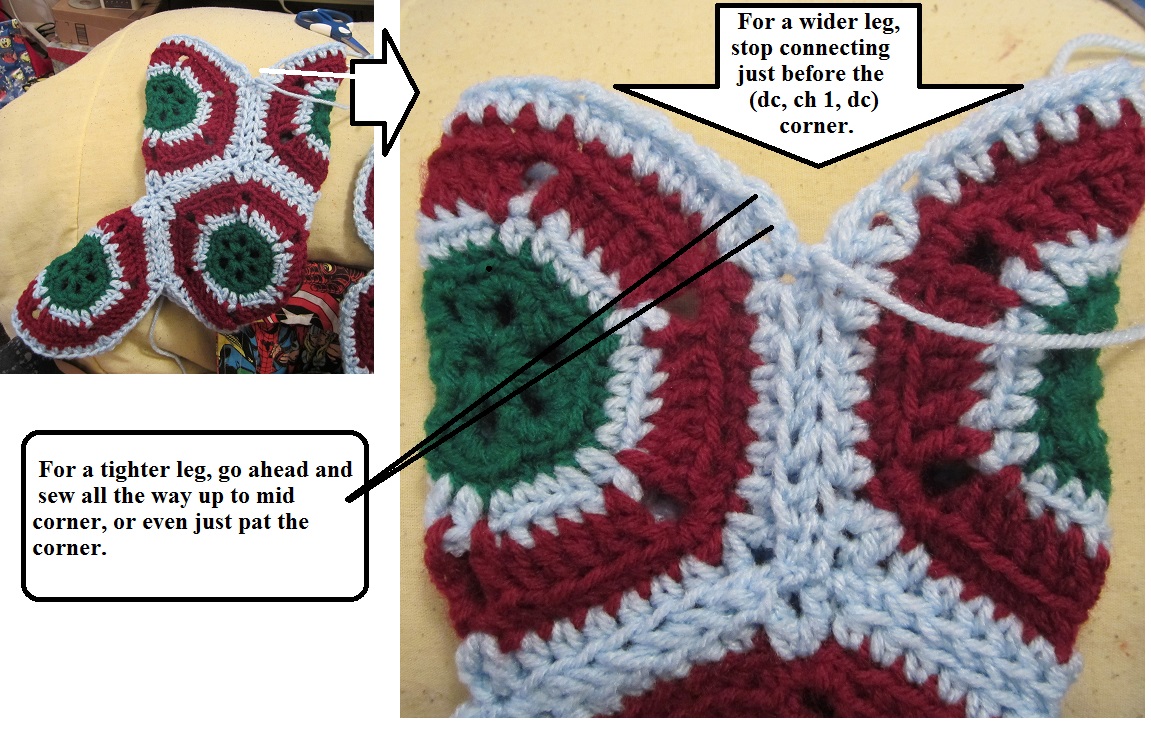
* Note for wide leg or tighter leg: For a smaller leg on these boots, sew the top of the hexagons together all the way up to the corner. For a wider leg, stop before the (dc, ch 1, dc) corners so that there will be more stretch to the top of the boot. If you choose the wide leg version, remember to check the top border notes for the changes to that too.

for a wider leg

Even wider leg

Shorter boot:

If you’d like a shorter boot, you can make one of these triangles and stitch it onto the front of the shoe so it will be smooth around the ankle for you to work a round to tie things together.

Triangle:

Rnd 1: Ch 3, jn with a sl st in first ch for form a ring. Ch 1, (sc, ch3 ) three times. Jn with a sl st in first sc.

Rnd 2: In ch-3 space after jn: (2sc, ch 1, dc, 2hdc). In next ch-3space: (Hdc, dc, ch 1, tr, ch 1, dc, hdc). In last ch-3 space: (2hdc, dc, ch 1, 2sc). Jn with sl st in first sc.

Rnd 3: Jn with a sl st in the ch space to the right of the tr stitch point. (sc, dc) in ch space, ch 1, (dc, sc) in next ch space. Sc in between the stitches up to the ch space of next corner. (Dc, tr, ch 1, tr, hdc) in the ch space. Hdc across to the next ch space. (Hdc, tr, ch 1, tr, hdc) in the ch space. Sc in between the stitches down to the first sc. Jn with a sl st in first sc. Fasten off.

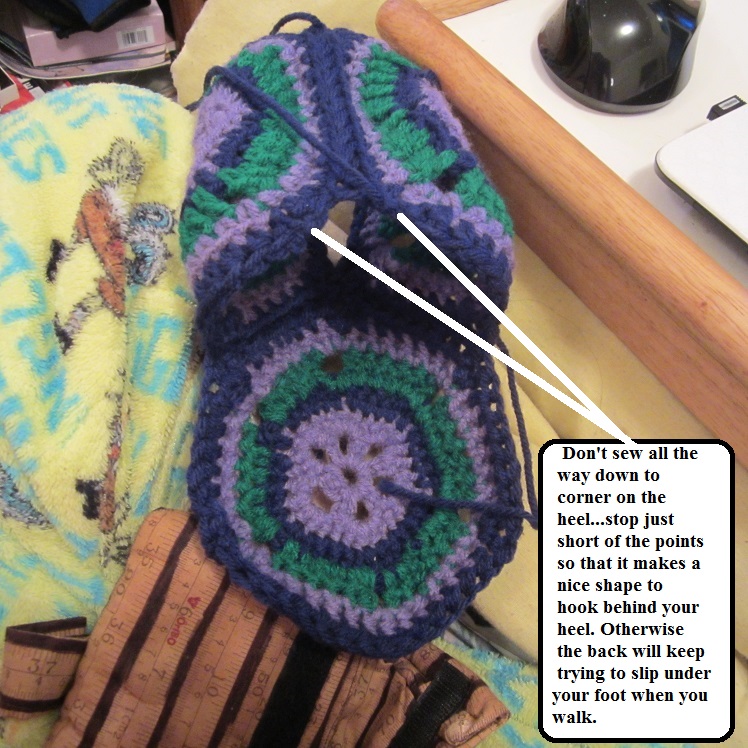
*Sew your boot together. Check out my zillion pictures to help you get a concept of how they fit together.

triangle
Bottom of shoe:

I use the really soft LionBrand homespun yarn to make the bottom of all my shoes because normal yarn feels a little rough to me to step on, and the LionBrand yarn is like walking on a cloud!

This could get tricky because I would suggest that you make a chain that is a tiny, tiny pit longer than your foot, but the problem is when you make a chain it is difficult to decide how tight to pull/stretch the chain to make an accurate judgement. I would say make the chain with your best judgement, add 1 extra chain, then sc in the second ch from hook and across the ch. At this point you can hold that row up to your foot and see if it works out how you were imagining; that way you don’t make the whole thing and then realize it’s too short or long.

Personally, this worked for me:

Rw 1: Ch 26, sc in the 2nd ch from hook and across.

Rw 2: Ch 1, turn, sc in same st and across. I repeated Rw 2 until I had 10 rows. That seems to work for normal and wide feet.
Top Border:

Then simply jn your chosen yarn with a sl st, ch 2, dc in same st and around. Jn with a sl st in the first dc. If it seems the ankle is too wide, you can tighten it here by adding some dc decreases evenly around the round. If it is too tight, you can add a few increases evenly throughout the round.

If you are choosing the wide leg version there may be a V shaped dip on each side of your boot where you don’t connect the hexagons all the way up. You’ll still hdc around, but when you get to each side, evenly add: 2 dc, 3 tr, 2 dc, with the center tr being in the deepest part of the V dip.

More pictures and notes on construction:

heel tutorial

IMG_3078

IMG_3137

IMG_3141

IMG_3152

IMG_3154

IMG_3145

IMG_3167

IMG_3168

*Note on sizing: I wear a size 8 1/2 to 9, and these that I made for my mom are a little snug, but they would stretch easily and fit me. So I bet these are a size 8. If you’d like to adjust these for different sizes, it would be easy to troublshoot by making the very first top/toe hexagon and draping it over your foot to get an idea if it’s working for you or not. To make it much smaller, you could do something like use an H or F hook, or a larger hook for a larger size. If it almost sits perfect but you think you might need it adjust just a little, then you could make all your changes on round 6. Replace the stitch with single crochets for a smaller fit, or double crochets or even treble crochet stitches to make them stretch more. That way you can use the same hook size and yarn type, yet you won’t have to unravel anything and spend so much trouble shooting time. You’ll just experiment with that very last round. That’s how I decided what stitch to add on the last round, myself. My mom’s feet are a little smaller than mine, but not much, so I pressed the first hexagon I made around my foot and looked at a picture of those boots to see how it compared to where it should be laying. Had it been a little small I would have added dc or tr, and if it was too big I could have left off that row all together, or added single crochet. So play with and see if you don’t wear an 8 or 9. You can figure it out! I believe in you!

sizinghexagonboots

Posted in Uncategorized | Tagged , , , , , , , , , , , , , , , , , , | 5 Comments

Crochet Lobo from Injustice: Gods Among Us

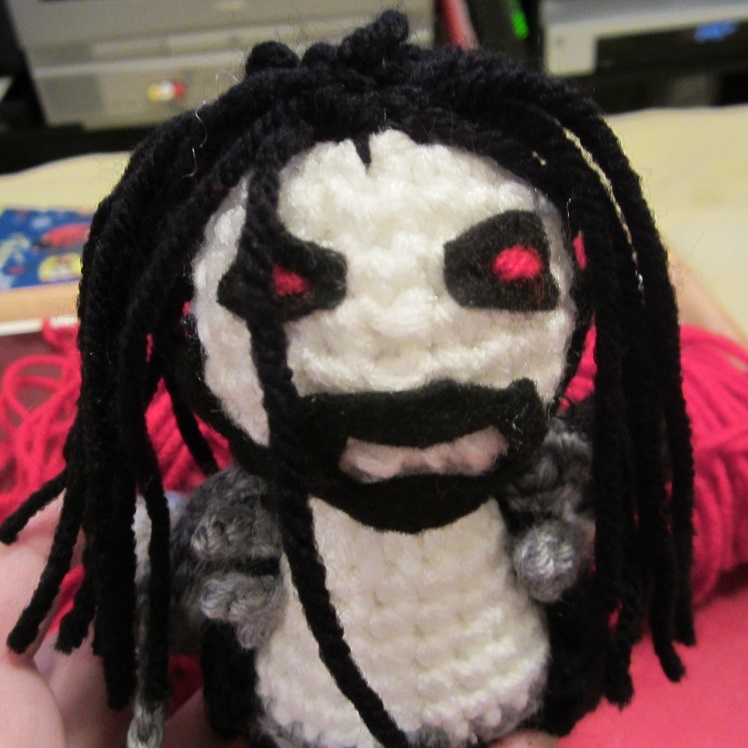
I made a crochet Lobo inspired by his character in the video game Injustice: Gods Among Us for one of our friends for a Christmas present! He turned out great! I’m so proud! I even added his shoulder spikes! I used the body pattern from the Creepy Cute Crochet book and just kinda made the rest up as I went along!


Lobo full view

Lobo and Mizzy Kitty

Lobo close up

Lobo side view

Lobo shoulder spikes

Injustice-Gods-Among-Us-Lobo-reveal

3008650-lobo

Posted in Uncategorized | Tagged , , , , , , , , , , , , , , , | Leave a comment

Camera Themed Case for Phone, Cigarettes, Camera, etc…FREE Crochet Pattern!

Phone/Cigarette/Camera Case

IMG_3092

Size K hook for everything but the button on top where you’ll use an F hook. Red Heart Super Saver Yarn. I use felt squares for the flash.
Front, back, and flap of the bottom part of the camera:

Ch 43.

Rw 1: With bottom color, sc in 2nd ch from hook and across.

Rw 2: Ch 1, sl st in same st. Pivot work so that you are working back up the chain. Ch 1, sc in same st and across.

Rws 3-8: Ch 1, turn, sc in same st and across. Do not fasten off yet.

Bottom of Camera:

At the end of Rw 8 you will creat the bottom of the camera. This will be Rw 9, but also the bottom of the camera. The camera is about 16 stitches wide, so when you fold it in three parts the front and back will be 16 wide and what’s left is the flap. To make the bottom of the camera you’re going to make three rows that are 16 stitches wide after Rw 8 and then later, after adding the top of the camera in this same manner, you can stitch the top of these three rows to the opposite side of the camera.

Rw 9: Ch 1, turn, and working in the back loops only, sc in same st and next 15 st.

Rw 10 and 11: Ch 1, turn, sc in same st and across. After Rw 10 fasten off leaving a tail long enought to sew the top of Rw 11 to the other side when you fold the front/back toward it.

You should now have the bottom half of the camera intact. If you would like to go ahead and sew it in place it won’t hurt anything and it might be easier to remember which end you will work these same three 16-stitch rows when you add the top of the camera so you don’t accidentally work the top of the camera onto the top flap part.

Front, back, and flap of the top part of the camera:

Jn the top color with a sl st at the first sc on the flap.

Rw 1: Ch 1, sc in same st and across.

Rw 2 -5: Ch 1, turn, sc in same st and across.

Row 6 will begin the top of the camera in the same way as Rws 9-11 created the bottom.

Rw 6: Ch 1, turn. Working in back loops only, sc in same st and next 15 st.

Rw 7-8: Ch 1, turn. Sc in same st and down the other 15 st. When you fasten off leave a tail long enough to fold down the top of the camera and sew it in place across from it to create the top part of the camera.

Border:

I like to jn the corresponding yarn along the top opening of the camera and sc across to make it look more smooth, and also along the flap where it may look uneven as well. Around the opening of the phone/cigarette/camera case, I sometimes decrease a time or two evenly if it appears a little wide or floppy.

IMG_3094

camera case

Lens:

With black:
Rnd 1: Ch 2, 6 sc in 2nd ch from hook. Jn with a sl st in first sc.

Rnd 2: Ch 1, 2sc in same st and in each st around. Jn with a sl st in first sc.

Rnd 3: Ch 1, 2sc in same st, sc in next st, (2sc, sc) around. Jn with a sl st in first sc. Fasten off and weave in ends.

Sides of camera lens:

Rnd 1: Join lens side-color yarn with a sl st in the front loop of any sc of Rnd 3. Working in the front (top of the lens) loops only: (Ch 1, sl st in next front loop) around. Jn with a sl st in first sl st/ch-1. Whichever looks more smooth.

Rnd 2: Working in the back loops of the same rnd where you just used the front loops, ch 1, sc in each st around and jn with a sl st in first sc. Fasten off leaving a tail lone enough to stitch the front loops of this rnd to the ch-1 parts of Rnd 1 and also to then stitch the lens to the camera.

Lens for camera case

Sew the lens to the camera, stuffing as you go along, and fold the top and bottom of the camera in place and sew them if you haven’t already. If you are going to add a felt flash, you might want to sew it on before you stitch the top and bottom in place…I stabbed myself with the needle several times trying to sew it on after the camera was already together.

camera case where to

Top button:

With an F hook:

Rnd 1: (This is the top) Ch 2, 6 sc in 2nd ch from hook.

Rnd 2: (This is the side) Ch 1, working in back loops only sc around and jn with a sl st in first sc. Fasten off leaving tail long enough to sew button to the top of the camera.
Handle:

Ch 42, dc in 3rd ch from hook and across. Ch 2, sl st in same st. Faste off leaving tail long enough to sew both ends together and sew the handle to the camera.

mizzycameracase

IMG_3100

Posted in Uncategorized | Tagged , , , , , , , , , , , , , , , , | 1 Comment

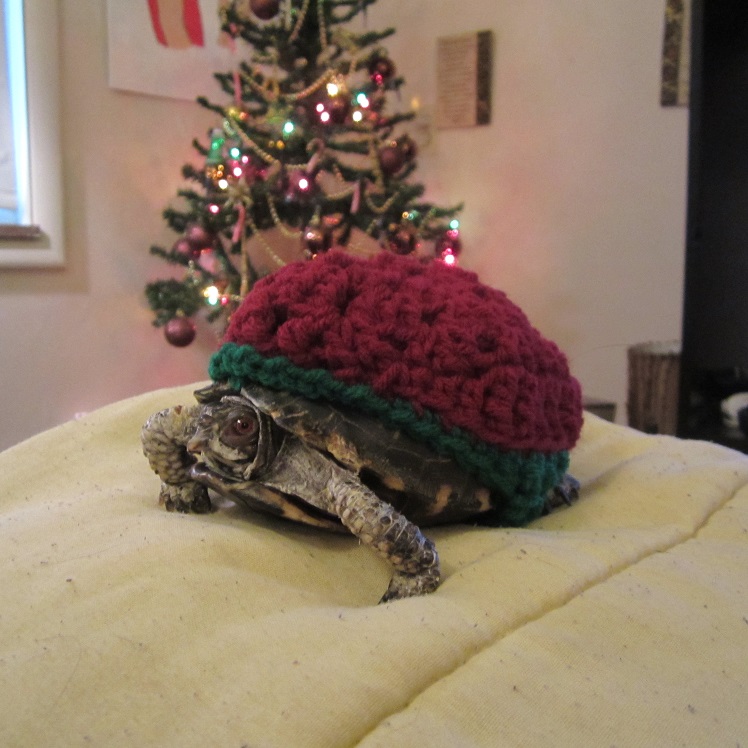
Turtle and Mizzy Kitty Cat’s Christmas Sweater

Turtlesweater

Behold! Turtle’s Christmas sweater!!! She wanted her picture in front of the tree, of course.

Note: Turtle’s may feel claustrophobic in clothing, unlike people and kitties and dogs…so only toss a sweater on your turtle for a few minutes for pictures, even if your turtle is as social and easy going as mine and doesn’t show any signs of giving a crap what strange things you put on her, hehehe.

Now for Mizzy Kitty’s Christmas sweater!!! If you love this sweater, I used my FREE kitty sweater pattern which you an find here.
mizzy sweater4

mizzy sweater3

Posted in Uncategorized | Tagged , , , , , , , , , , , , , , , , , , , | 1 Comment

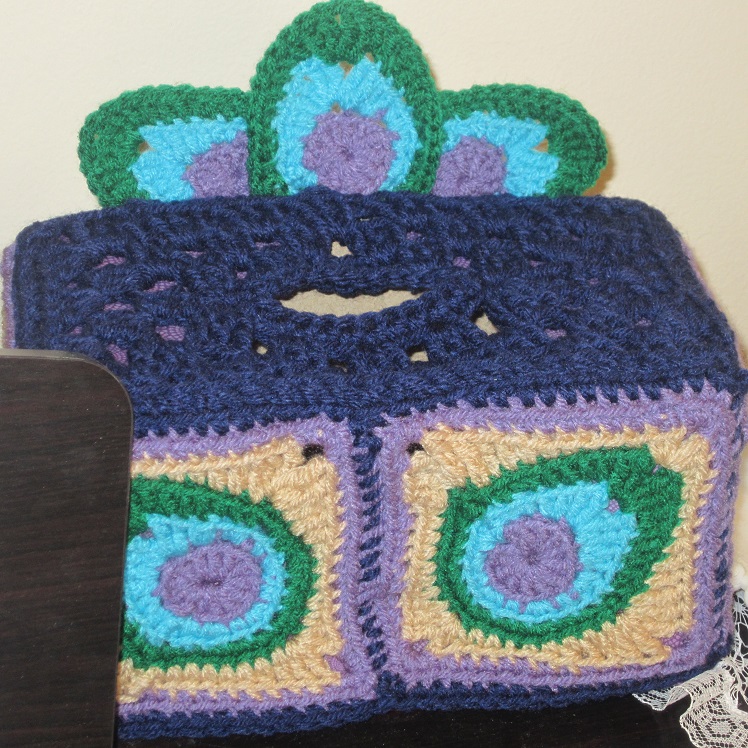
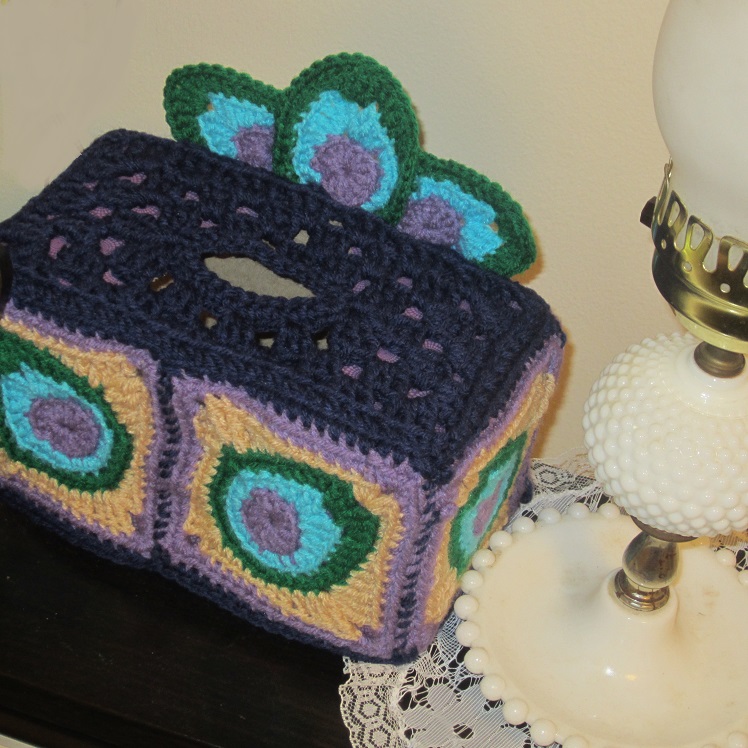
Peacock Tissue Box Cover (free crochet pattern)

Peakcock box1

Tissue Box Cover (Peakcock Version)

Sides:

The peacock square is not my own pattern. I made 6 squares from the FREE pattern you can find here:
http://bananamoonstudio.blogspot.com/2013/03/happy-national-crochet-month.html
The only thing different I did was that I used an F (3.75MM) hook for Rnds 1, 2, and 3, and then I used a size K (6.50MM) hook for Rnds 4 and 5. (And Red Heart Super Saver Yarn)

Then I used a yarn needle and sewed the squares together at the sides using the back loops only of the side rows on the squares.

Once the squares were sewed into a closed circle to create the sides of the tissue box, I joined my yarn with a sl st on the bottom of the tissue cover, (using a size F hook again), and working in the back loops only I sc around adding sc decreases between each of the squares to pull them together a little more smoothly. I repeated to line the top of the squares as well.

For the top, I used a K hook:

Rnd 1: With color A, Ch 24, join in the first ch to form a ring. Ch 1, sc in same ch and around. Jn with a sl st in first sc. (24 sc)

Rnd 2: In the same st as join, (ch 3, 2tr, ch 3, 3tr, ch 3, 3tr), *sk next 2 st, 3dc in next st. Repeat from * 2 more times. Sk next 2 st, (3 tr, ch 3, 3tr, ch 3, 3tr) in next st to create the second side. *sk next 2 st, 3dc in next st. Repeat from * 2 more times. Jn with a sl st in the first tr.

Rnd 3: With color B, Jn with a sl st in the corner after where you joined Rnd 2. In this corner, (ch 2, dc, tr, ch 3, tr, 2dc), and in the next corner, (2dc, tr, ch 3, tr, 2dc), 3dc in the space between the fans across to next corner. (2dc, tr, ch 3, tr, 2dc) in each of the two cornerns, then 3dc in the space between the fans across until you’re back to the very first ch-2 where you began the round. Jn with a sl st in the first dc.

Rnd 4: With color A, Jn with a sl st in the corner after where you joined Rnd 3. In the corner space, ch 2, *(2dc, tr, ch 3, tr, 2dc). Work 3dc in the open space between the two corners. (2dc, tr, ch 3, tr, 2dc) in next corner space. 3dc in each space between the fans across to the next corner. Repeat from * and jn with a sl st in first dc.

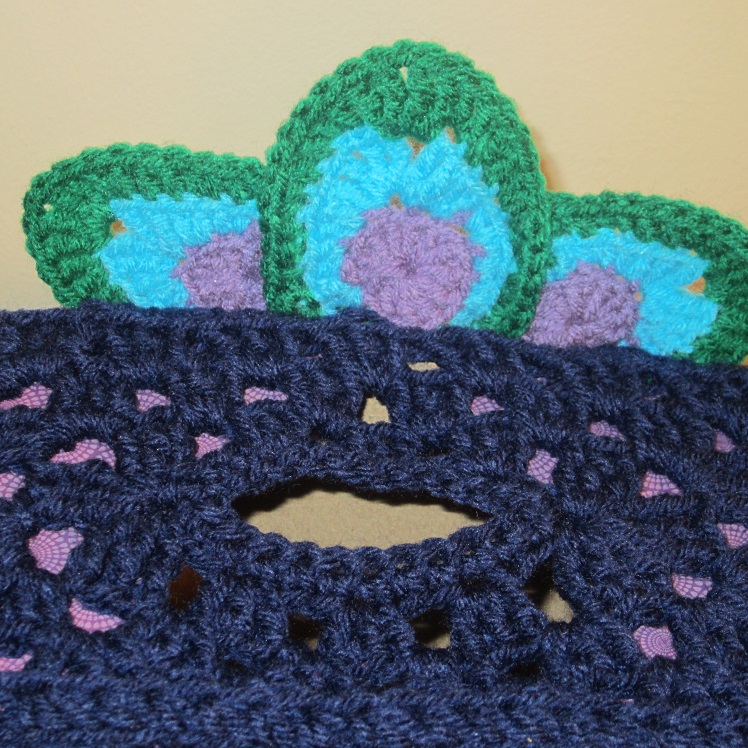
I then used a yarn needle to sew to top to the top edge of the sides. If you’d like you could make several Peacock feathers from the inside of the square pattern, stopping after round 3, and then place the feathers around wherever you want!

peacockbox2 peacockbox3

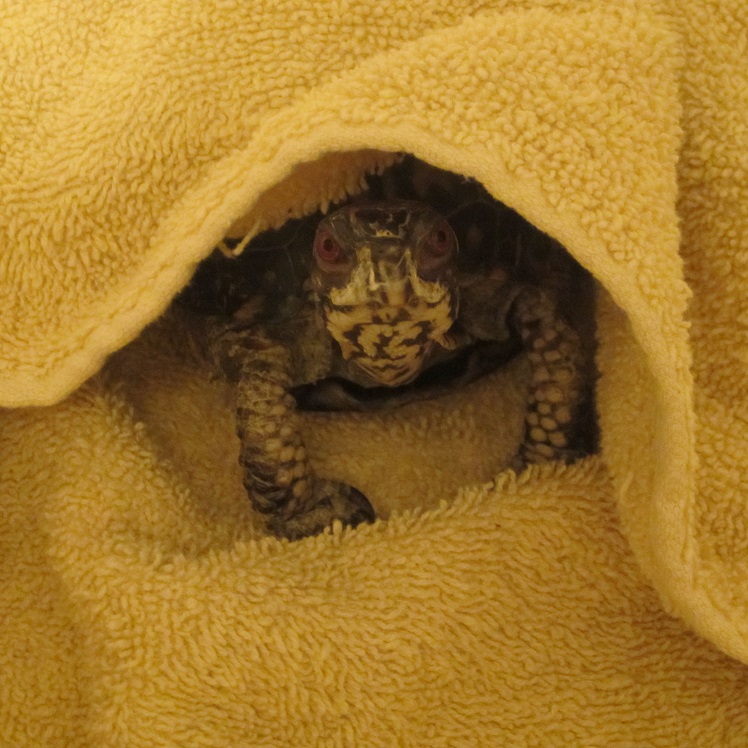
A picture of Turtle pretending to be a turtle taco?? How did this get in here?

A picture of Turtle pretending to be a turtle taco?? How did this get in here?

Posted in Uncategorized | Tagged , , , , , , , , , , , | Leave a comment

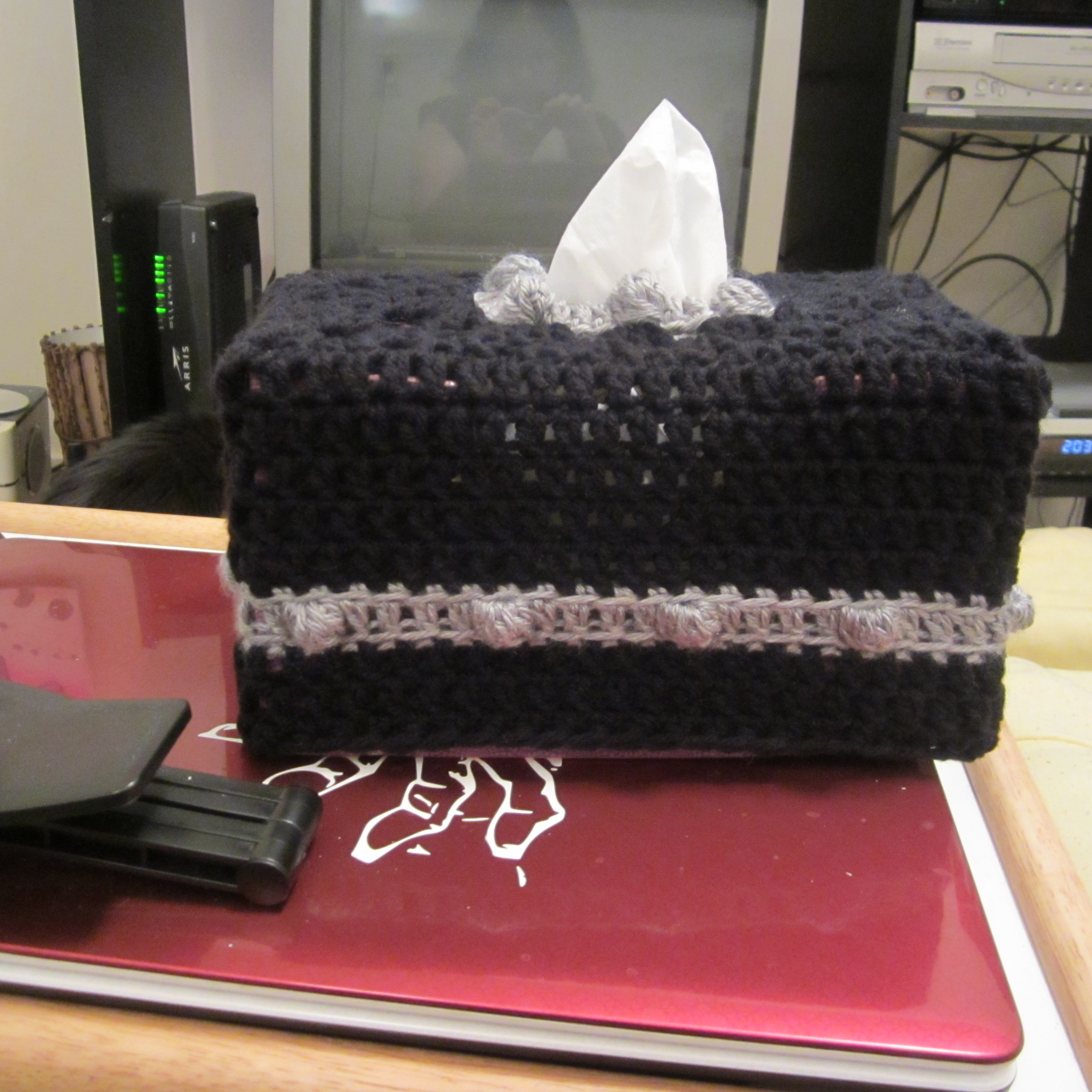
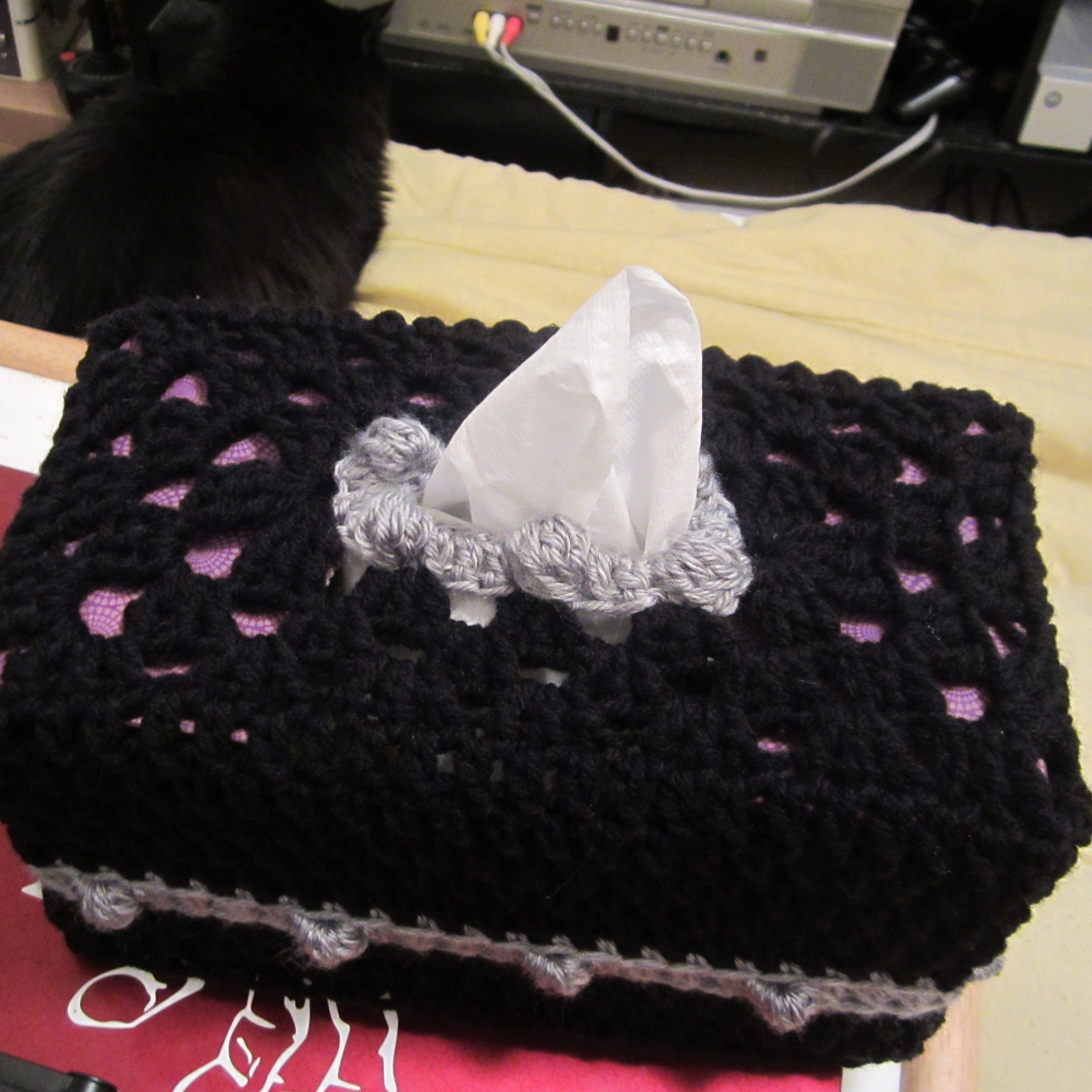
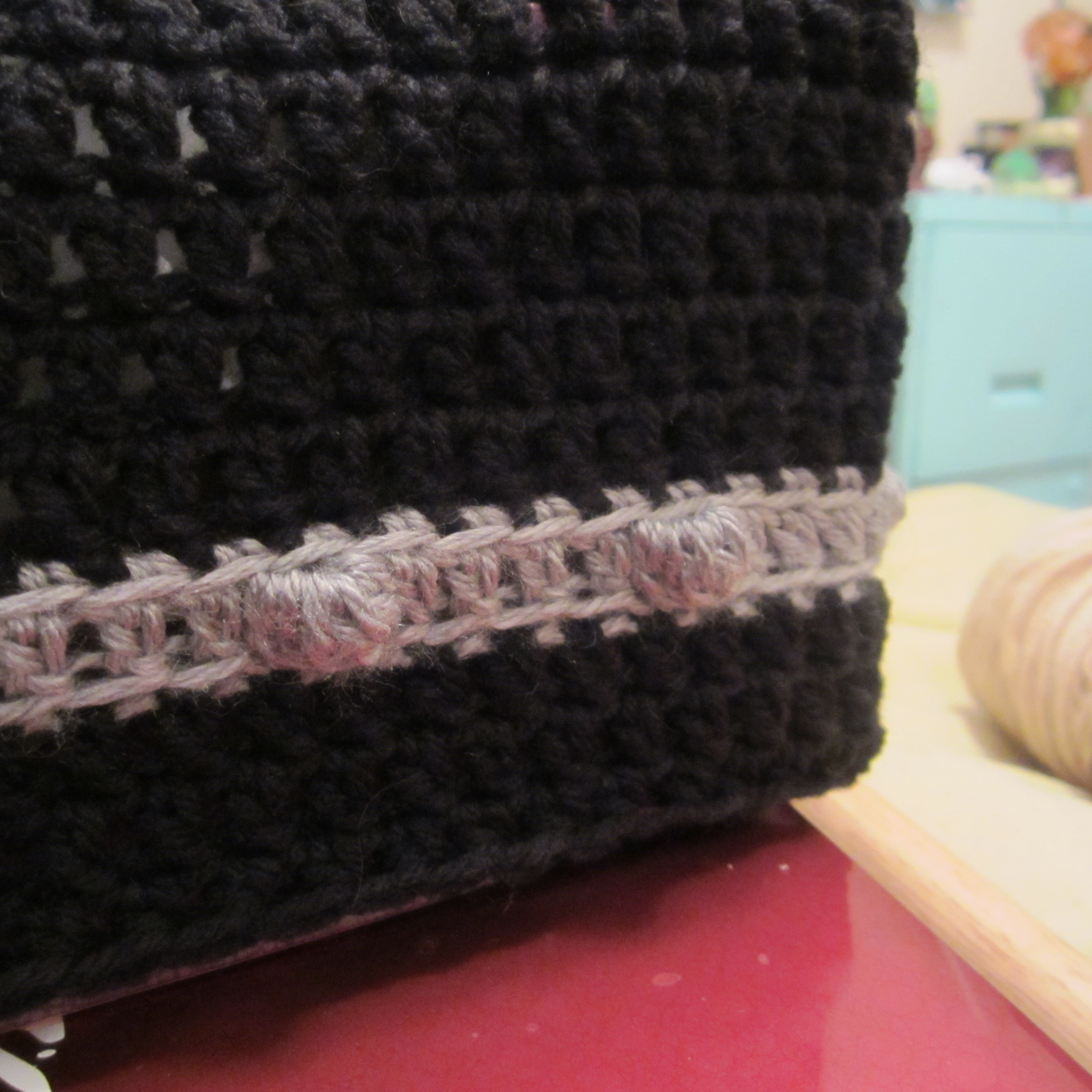
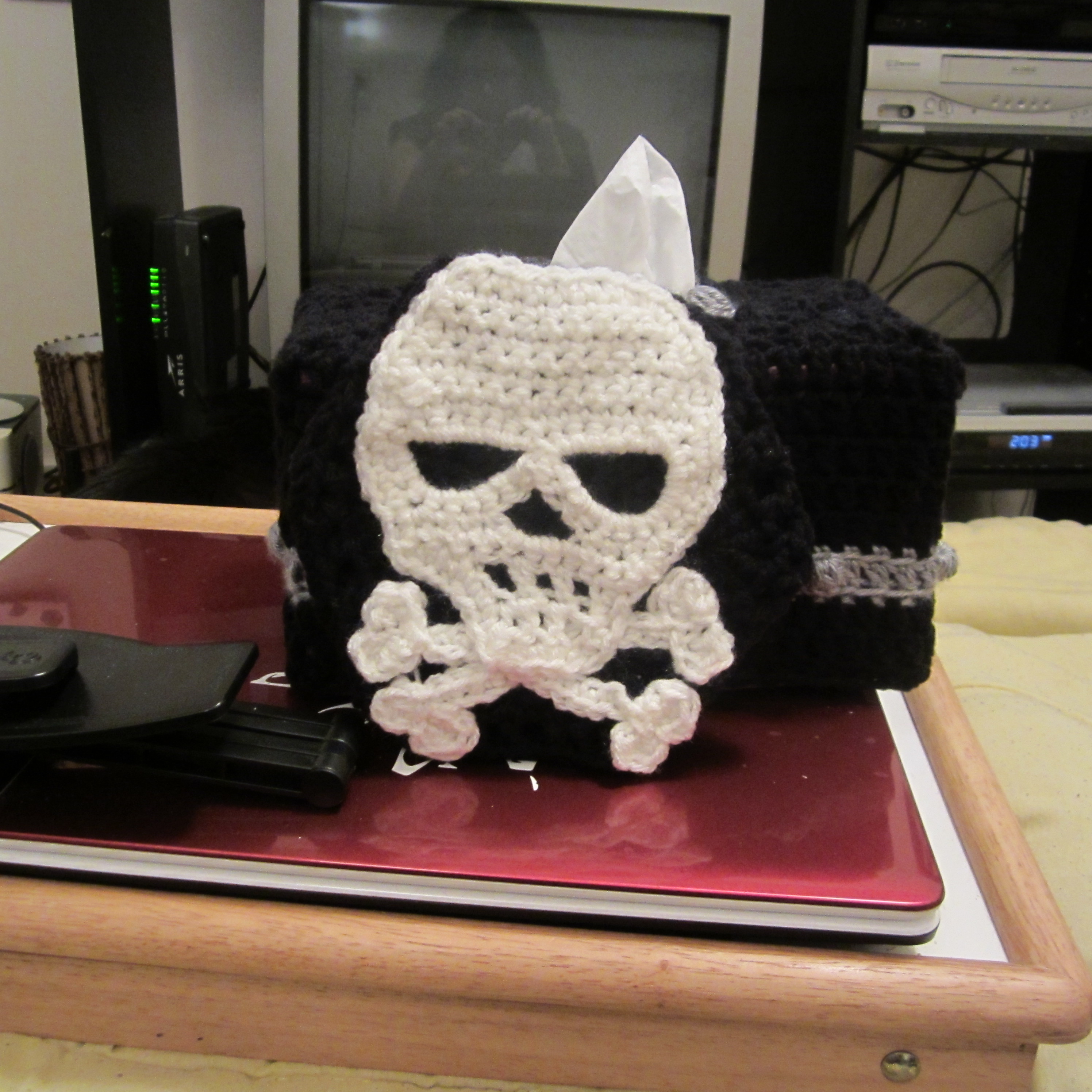
Most Metal Tissue Box Cozy (free crochet pattern)

IMG_3028 IMG_3029 IMG_3030

Tissue Box Cover (Most Metal Version)

Ch 24. Jn with a sl st in first ch to form a ring.

Rnd 1: With gray: Ch 2, (counts as first dc), dc in next 2 st, 6dc bobble. *3dc, 6dc bobble in next st and repeat from * around. Jn with a sl st in first dc. You should have 24 stitches total with counting the first ch-2 as a st and counting each bobble as one stitch.

Rnd 2: With black: In the same st as join from Rnd 1, (ch 3, 2tr, ch 3, 3tr, ch 3, 3tr), *sk next st, 3dc in next st. Repeat from * 2 more times. Sk next 2 st, (3 tr, ch 3, 3tr, ch 3, 3tr) in next st to create the second side. *sk next 2 st, 3dc in next st. Repeat from * 2 more times. Jn with a sl st in the first tr.

Rnd 3: Sl st to nearest corner. In this corner, (ch 2, dc, tr, ch 3, tr, 2dc), and in the next corner, (2dc, tr, ch 3, tr, 2dc), 3dc in the space between the fans across to next corner. (2dc, tr, ch 3, tr, 2dc) in each of the two cornerns, then 3dc in the space between the fans across until you’re back to the very first ch-2 where you began the round. Jn with a sl st in the first dc.

Rnd 4: Sl st to nearest corner. In the corner space, ch 2, *(2dc, tr, ch 3, tr, 2dc). Work 3dc in the open space between the two corners. (2dc, tr, ch 3, tr, 2dc) in next corner space. 3dc in each space between the fans across to the next corner. Repeat from * and jn with a sl st in first dc.

Rnd 5: Sl st to nearest corner, ch 3, tr in same corner. Dc in each stitch all the way around adding one tr in each corner chain space.

Rnd 6: Ch 2, dc around. Jn with a sl st in first dc.

Rnds 7-9: Repeat Rnd 6.

Rnd 10: With gray: Jn with a sl st. Ch 1, sc in same st as jn. Sc around. Jn with a sl st in first sc.

Rnd 11: Working in back loops only: Ch 2, dc in next 3 st, 6 dc bobble in next st. *dc in next 4 st, 6dc bobble in next st. Repeat from * around. Jn with a sl st in first dc.

Rnd 12: Working in back loops around: Ch 1, sc in same st as join. Sc around. Jn with a sl st in first sc.

Rnd 13: With black: Ch 2, dc in next st and around. Jn with sl st in first dc.

Rnd 13: (Skirt round.) Jn chosen color with a sl st in any space between fans. Ch 2, 5dc in same space. (Sc in next space, 6dc in next space) around. Jn with a sl st in first dc. Fasten off and weave in ends.

Most Metal Ice Pack Cozy

For the matching cozy, I used a K hook to make two of the hexagons on this awesomely awesome cute as ever blog: Bunny Mummy.

As for the skull and crossbones, I cannot find the pattern I used online!!! UGH!!! It’s driving me crazy! But if you need a pattern to make the accessory, here are some suggestions of super creative ones I found that are free patterns:

This one on KirstinsKrazyKnits. Luv, luv luv!!!!!!!

This totally rad one on Speckless. You outta go ahead and make that cuff bracelet while you’re at it!!

IMG_3032 IMG_3033 IMG_3034 IMG_3035

Posted in Uncategorized | Tagged , , , , , , , , , , , , , , , , , , , , , | 1 Comment

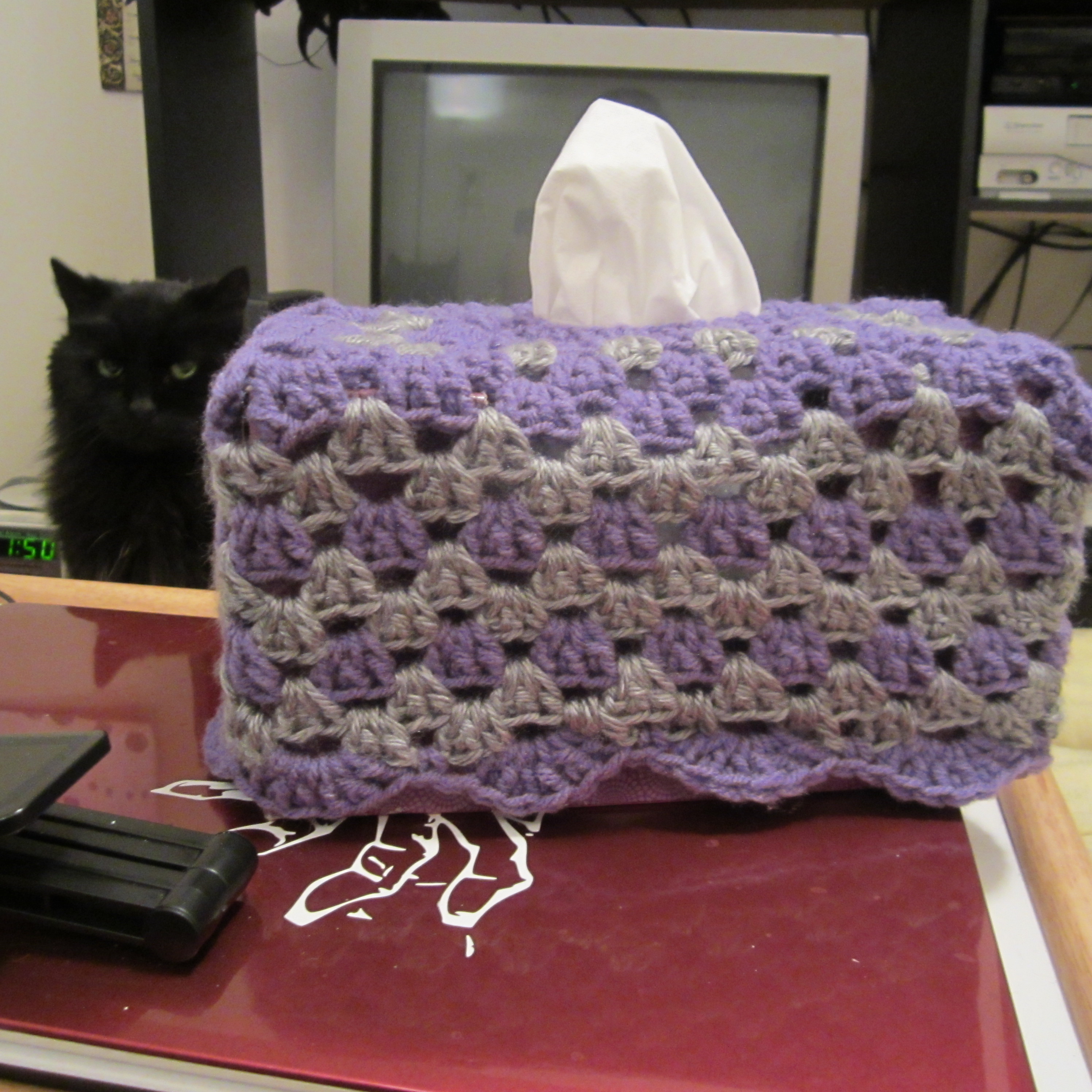
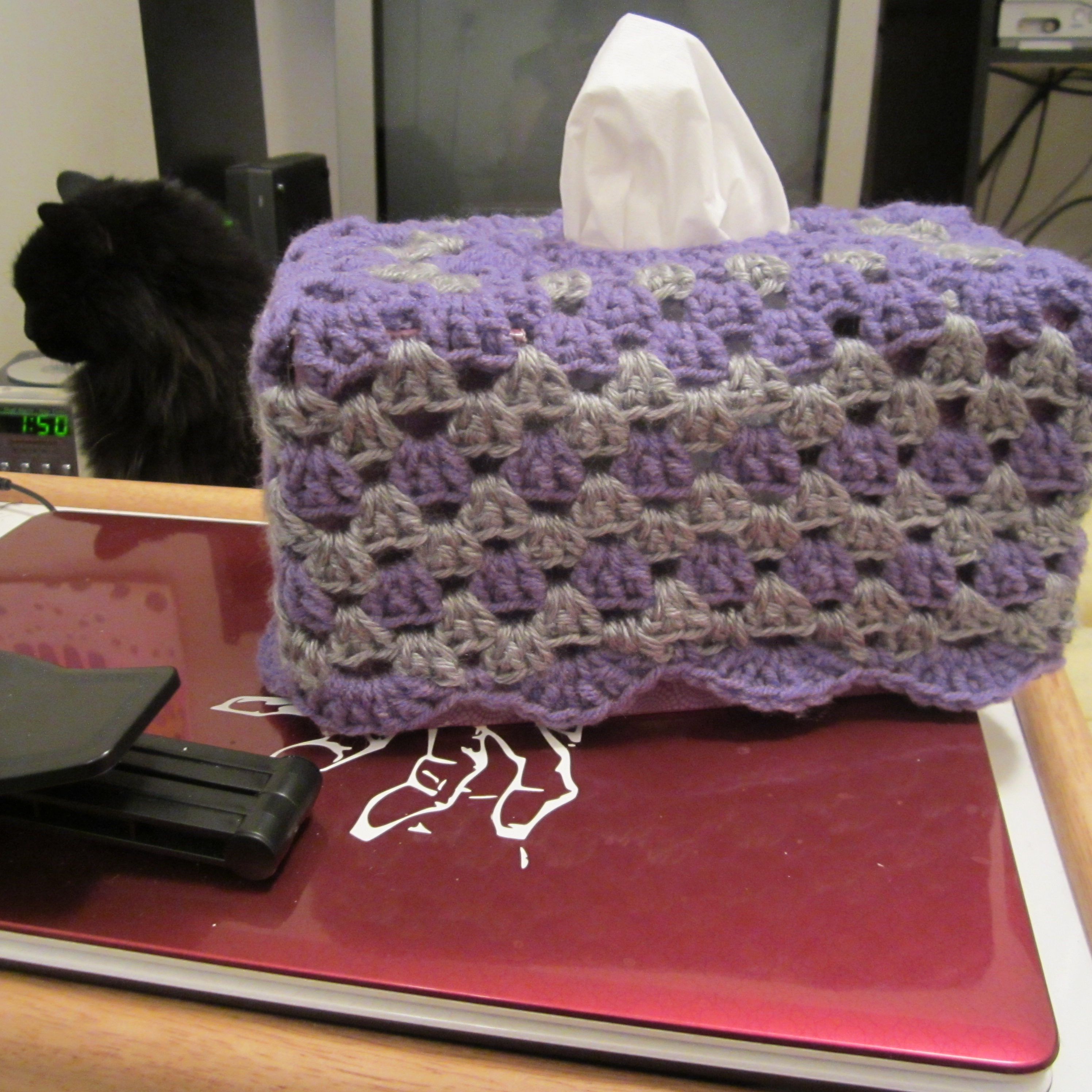
Tissue Box and Ice Pack Cozy (free crochet pattern)

IMG_3018IMG_3020

IMG_3024 IMG_3026

Inspired by this tissue box cover on this blog that uses a smaller hook:  http://theroyalsisters.blogspot.com/2010/09/granny-tissue-box-tutorial.html

My ghoulz know by now that I’m kind of a lazy crocheter, so when I find a lovely pattern I’d like to try, I’m very likely to make up my own version using a larger hook. I saw a pattern like this on the blog I linked to above, and it is soooooo pretty! So of course I scanned the pattern and got the basic gist and then created my larger hook version based on that one. You should check out that link if you’re more patient than I, because often times smaller hooks make for better detail. I’m super happy with my quicker version for now, though, because I have many Christmas projects to make!!

Tissue Box Cover (Granny Version) Pattern

Size K (6.50 MM) hook and Red Heart super saver yarn.

Rnd 1: With color A, Ch 24, join in the first ch to form a ring. Ch 1, sc in same ch and around. Jn with a sl st in first sc. (24 sc)

Rnd 2: In the same st as join, (ch 3, 2tr, ch 3, 3tr, ch 3, 3tr), *sk next 2 st, 3dc in next st. Repeat from * 2 more times. Sk next 2 st, (3 tr, ch 3, 3tr, ch 3, 3tr) in next st to create the second side. *sk next 2 st, 3dc in next st. Repeat from * 2 more times. Jn with a sl st in the first tr.

Rnd 3: With color B, Jn with a sl st in the corner after where you joined Rnd 2. In this corner, (ch 2, dc, tr, ch 3, tr, 2dc), and in the next corner, (2dc, tr, ch 3, tr, 2dc), 3dc in the space between the fans across to next corner. (2dc, tr, ch 3, tr, 2dc) in each of the two cornerns, then 3dc in the space between the fans across until you’re back to the very first ch-2 where you began the round. Jn with a sl st in the first dc.

Rnd 4: With color A, Jn with a sl st in the corner after where you joined Rnd 3. In the corner space, ch 2, *(2dc, tr, ch 3, tr, 2dc). Work 3dc in the open space between the two corners. (2dc, tr, ch 3, tr, 2dc) in next corner space. 3dc in each space between the fans across to the next corner. Repeat from * and jn with a sl st in first dc.

Rnd 5: With color B, Jn in any space between the fans that is not a corner, (ch 2, 2dc) in same space. Work 3tr in every corner and 3dc in the spaces around. Jn with a sl st in the first dc.

Rnds 6-12: Varying colors in each round, 3dc in each space between the fans. Jn each rnd with a sl st in first dc.

Rnd 13: (Skirt round.) Jn chosen color with a sl st in any space between fans. Ch 2, 5dc in same space. (Sc in next space, 6dc in next space) around. Jn with a sl st in first dc. Fasten off and weave in ends.

Ice Pack Cozy

I also made a matching ice pack cozy to go along with the tissue box cozy. I got the FREE pattern here, and I used a size K hook to make it, made two of them, and then sewed them together all except for the top so you can stick ice into a sandwich baggie and slide it right in there. I used two simple chains on the top to tie it together to keep the ice pack inside.

IMG_3023

Posted in Uncategorized | Tagged , , , , , , , , , , , , , , , | 2 Comments